

Seawater Desalination Equipment for Island Water Supply
Freshwater supply is often one of the most difficult infrastructure challenges for islands. Unlike mainland cities, many islands have limited groundwater reserves, small freshwater catchments, or highly seasonal rainfall. At the same time, transporting bottled or bulk water from the mainland can increase operating costs and make the local water supply vulnerable to weather, transportation schedules, and changes in demand.
Seawater Desalination equipment offers another way to address this problem. By using seawater as the feed source and removing dissolved salts through seawater reverse osmosis (SWRO), an island can produce freshwater close to where it is needed. The technology can be applied to small communities, hotels, resorts, residential areas, ports, offshore facilities, and other remote locations.
However, installing an SWRO system on an island is not simply a matter of selecting an RO membrane and high-pressure pump. The complete system needs to match the local seawater conditions, daily water consumption, available power supply, installation space, storage capacity, and maintenance capabilities.
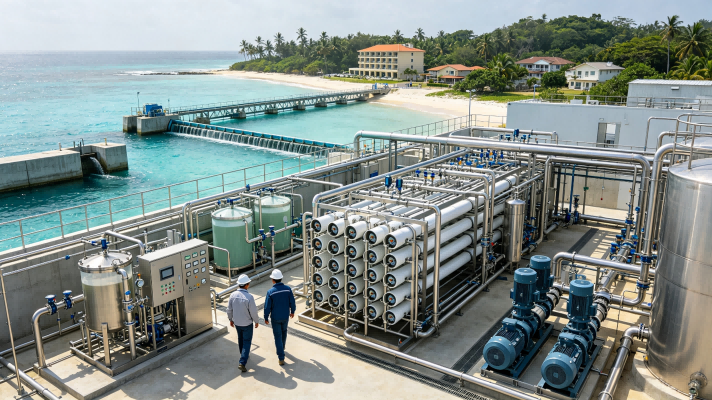
Island water demand can change considerably throughout the year. A small island may have relatively low demand during the off-season but experience a significant increase when tourists arrive. Hotels and resorts can also create short periods of high water consumption because of guest rooms, kitchens, laundry, swimming pools, landscaping, and other facilities.
Traditional freshwater sources may not always provide enough capacity to handle these changes.
Groundwater extraction, for example, can be limited by the size and quality of the aquifer. Excessive extraction may also contribute to seawater intrusion in some coastal areas. Rainwater collection depends heavily on local climate and storage capacity.
Seawater is different because it is available continuously around the island. With appropriate intake, pretreatment, and Desalination Equipment, it can become a stable source for freshwater production.
The practical objective is not necessarily to desalinate as much seawater as possible. A better approach is to design the system around actual water demand and operating conditions.
A typical Seawater Desalination System for an island includes several major stages:
Seawater intake
Pretreatment
Cartridge filtration
High-pressure pumping
Seawater reverse osmosis
Post-treatment
Freshwater storage
Distribution to users
Each stage has a specific role.
Seawater first enters the system through an intake structure. Depending on the location and local conditions, the intake may use an open-ocean intake, beach well, subsurface intake, or another engineered arrangement.
The seawater then passes through pretreatment equipment. Suspended solids, turbidity, microorganisms, and other contaminants need to be controlled before the water reaches the RO membranes.
After filtration, a high-pressure pump provides the pressure required for reverse osmosis. The pressurized seawater enters the RO pressure vessels, where the membranes allow water to pass while retaining most dissolved salts.
The resulting permeate is then treated according to its intended use. Depending on the application, post-treatment may include pH adjustment, remineralization, disinfection, or other conditioning processes.
Finally, the treated water is stored in tanks before entering the island's distribution network.
The quality of the water entering the SWRO system has a direct influence on pretreatment requirements and membrane performance.
An open-ocean intake is one common solution. It can provide a relatively large volume of seawater, but the intake must be designed to manage suspended solids, marine organisms, algae, and seasonal changes in water quality.
A beach well or subsurface intake can provide another option where local geology permits. Because the seawater passes through natural formations before reaching the collection system, some suspended particles and biological matter may be reduced.
The appropriate intake method depends on shoreline conditions, seabed characteristics, water depth, local regulations, construction requirements, and required production capacity.
For island projects, the intake should therefore be considered as part of the overall desalination system rather than as a separate civil engineering issue.
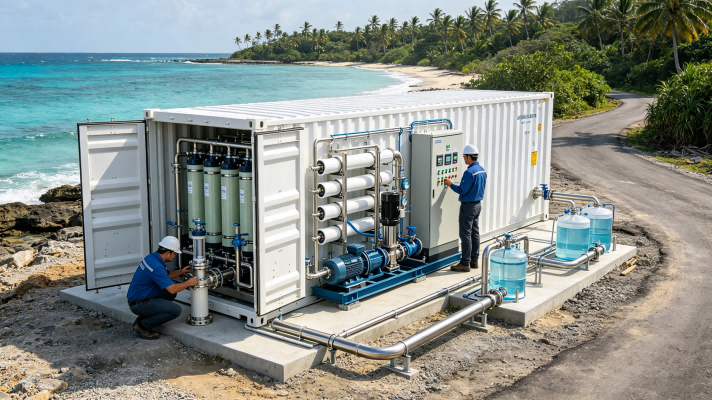
Seawater contains more than dissolved salts. It can also contain suspended solids, microorganisms, organic matter, and other substances that may affect RO membrane operation.
A typical pretreatment arrangement may include multimedia filtration, ultrafiltration, cartridge filtration, chemical dosing, or combinations of these technologies.
The exact configuration depends on the source water.
For example, seawater with relatively high turbidity or seasonal algae activity may require stronger pretreatment than a cleaner offshore source. During storms or heavy rainfall, coastal water quality can also change rapidly.
Good pretreatment helps reduce membrane fouling and protects the stability of the downstream high-pressure RO system.
For an island installation where technical staff may be limited, pretreatment should also be designed with practical maintenance in mind. Filters, dosing systems, pumps, valves, and instruments need to remain accessible for inspection and service.
Seawater reverse osmosis is widely used for producing freshwater from seawater because it can operate continuously and can be configured for different production capacities.
During operation, a high-pressure pump sends pretreated seawater into the RO membrane vessels. The membranes separate the feed into two main streams: permeate and concentrate.
The permeate becomes the freshwater product, while the concentrate contains most of the rejected salts and is managed through an appropriate discharge or brine-treatment system.
The operating pressure depends on feedwater salinity, temperature, membrane characteristics, recovery, and other design conditions.
seawater temperature is also important. Cold seawater generally has higher viscosity, which can reduce membrane water permeability and affect permeate production. Warmer seawater can increase membrane flux, but operating conditions still need to remain within the manufacturer's specified limits.
This is one reason island desalination systems should be designed using actual local seawater data rather than relying only on nominal equipment capacity.
Capacity is one of the first questions to answer when designing an island water supply system.
The required capacity should be based on more than the average daily water consumption.
A practical assessment may include:
Number of residents
Number of hotel rooms
Seasonal tourist population
Daily domestic consumption
Restaurant and kitchen demand
Laundry requirements
Public facilities
Industrial or commercial demand
Fire and emergency water requirements
Water storage capacity
Future expansion
For a resort, for example, water demand can increase significantly during peak occupancy.
A system designed only around the annual average may not provide enough water during the busiest periods. On the other hand, excessive oversizing can increase equipment cost and cause the system to operate far below its intended design point.
A better approach is to consider average demand, peak demand, operating hours, storage capacity, and possible future expansion together.
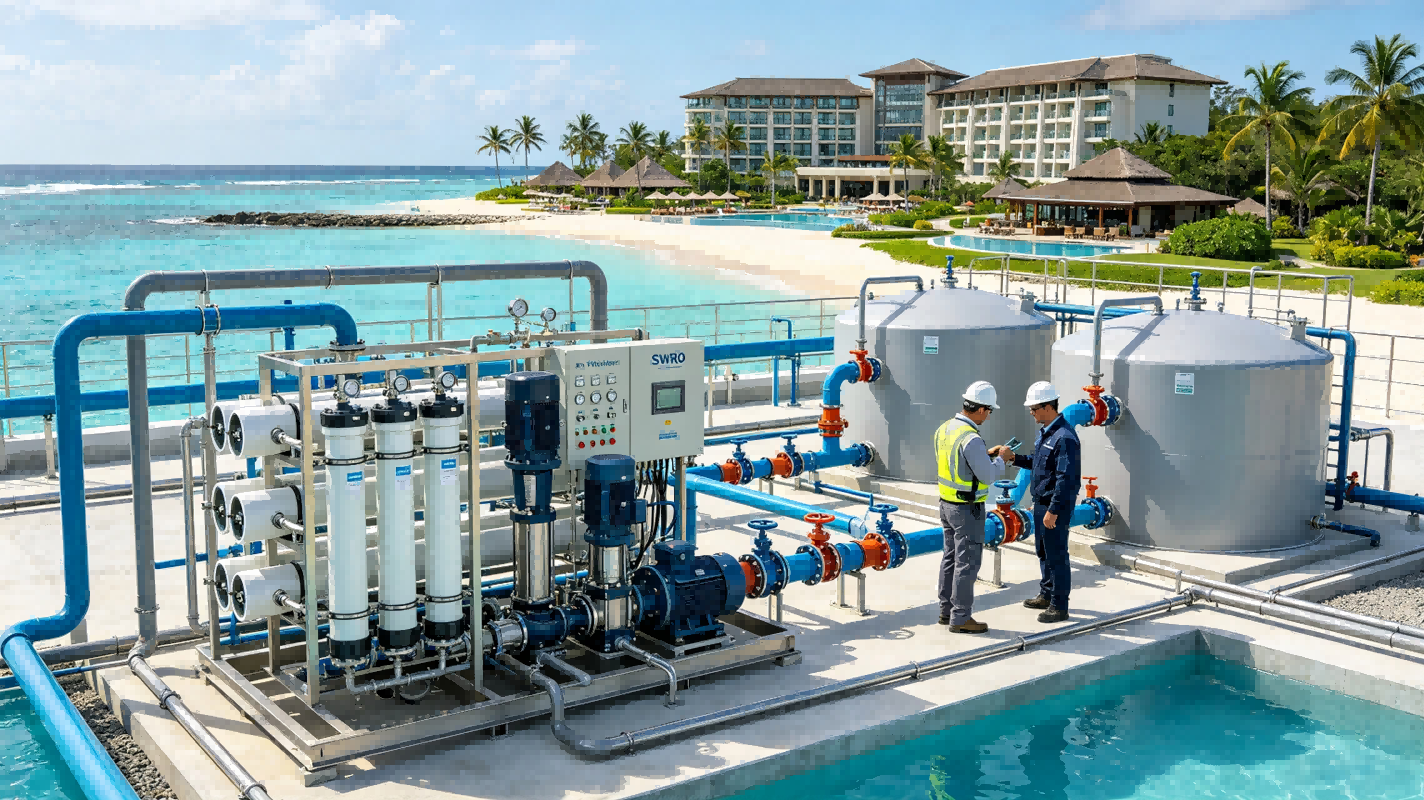
Containerized Seawater Desalination Equipment can be useful when installation space is limited or when equipment needs to be transported to a remote location.
Major components such as pretreatment filters, high-pressure pumps, RO pressure vessels, control panels, dosing systems, and associated piping can be integrated into a containerized configuration.
This approach can simplify transportation and on-site installation.
It can also provide a more controlled equipment environment, which is useful in remote locations where building a dedicated equipment room may be expensive or time-consuming.
However, containerized equipment still requires proper foundations, electrical connections, seawater intake and discharge arrangements, ventilation, drainage, and access for maintenance.
The container itself does not replace good system engineering. It is simply one practical way to package the treatment equipment.
Desalination equipment does not always need to operate at exactly the same rate as water consumption.
Freshwater storage can provide a buffer between production and demand.
For example, the SWRO system can operate during scheduled periods and fill a freshwater storage tank. During periods of high consumption, the stored water can supplement the desalination output.
This arrangement can be particularly useful for island resorts, where water consumption may change throughout the day.
Storage capacity should be considered together with desalination capacity. A system with sufficient membrane capacity but inadequate storage may still experience supply pressure during demand peaks.
The storage tank material and construction should also be selected according to water quality, environmental conditions, installation location, and local requirements.
High-pressure pumping is one of the major energy-consuming parts of an SWRO system.
For an island project, the available electricity supply can therefore have a significant influence on system design.
Some islands have stable grid power, while others rely on diesel generators, solar power, wind power, battery systems, or hybrid energy sources.
Energy recovery equipment can help reduce the power requirement of larger SWRO systems by recovering energy from the high-pressure concentrate stream.
Where renewable energy is available, the desalination system can also be designed to work with variable power availability. This requires careful consideration of operating schedules, storage, pump control, and freshwater demand.
The key point is that water production and energy supply should be planned together.
Island desalination equipment operates in a salt-rich environment, often close to the sea.
Chlorides, humidity, salt spray, temperature changes, chemicals, and high-pressure operation can all contribute to material degradation.
Material selection therefore matters throughout the system.
Depending on the component and operating conditions, equipment may use stainless steel, duplex or super duplex stainless steel, titanium, FRP, engineering plastics, or other corrosion-resistant materials.
The high-pressure section requires particular attention because components must withstand both seawater corrosion and mechanical stress.
Pumps, valves, pressure vessels, fittings, piping, fasteners, and instrumentation connections should be considered individually rather than assuming that one material is suitable for every part of the system.
Good fabrication, welding, surface treatment, and installation practices are also important for long-term reliability.
Island facilities may not have a large team of water-treatment specialists available around the clock.
Automation can therefore make a significant difference.
A modern SWRO control system can monitor parameters such as:
Feed pressure
RO pressure
Permeate flow
Concentrate flow
Conductivity
Pressure difference
Temperature
Tank level
Pump status
Pretreatment operating conditions
Automatic start and stop sequences can also reduce unnecessary manual intervention.
However, automation should not be treated as a replacement for maintenance. Operators still need to inspect filters, pumps, valves, dosing systems, electrical equipment, and membrane performance.
Remote monitoring can be particularly useful for island projects because operating data can be reviewed from a central location when local technical resources are limited.
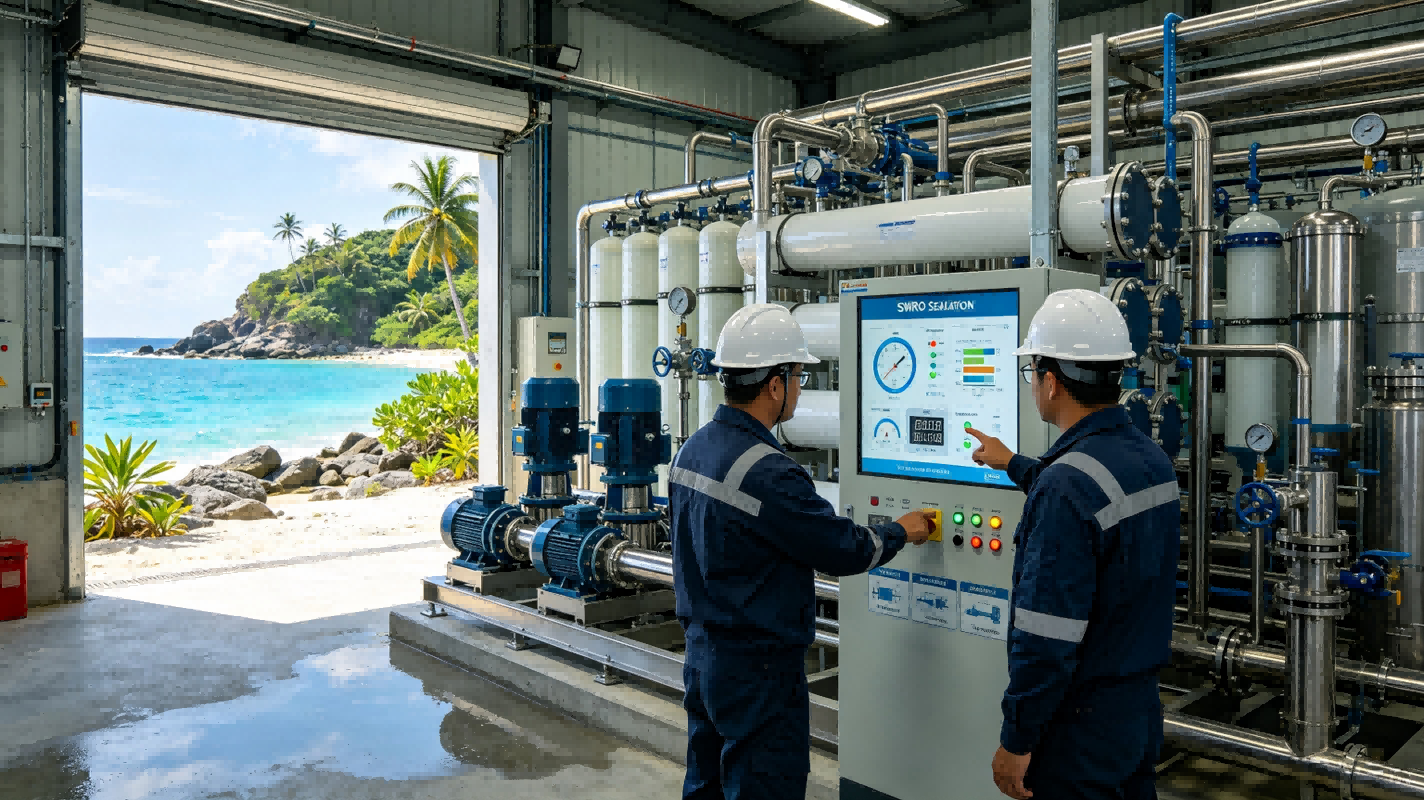
The concentrate stream from an SWRO system contains a higher salt concentration than the original seawater.
For coastal island projects, controlled marine discharge may be considered where permitted and where the discharge system is properly designed.
The outfall and diffuser arrangement can help promote mixing with surrounding seawater. The final approach must follow applicable environmental requirements and site-specific assessments.
For locations with stricter discharge requirements or limited receiving-water capacity, additional brine treatment may be required.
Options can include further concentration, water recovery, evaporation, crystallization, or other treatment technologies.
The correct solution depends on the local environment, regulations, system recovery, project scale, and operating cost.
A seawater desalination system should be designed with maintenance in mind from the beginning.
Operators need access to cartridge filters, pumps, valves, instruments, chemical dosing equipment, RO pressure vessels, and other components.
Consumables should also be considered. Cartridge filters, chemicals, membrane elements, lubricants, and replacement parts may need to be transported to remote islands.
This logistical factor can influence the overall operating strategy.
For example, maintaining an appropriate inventory of commonly replaced components can reduce downtime when shipping schedules are limited.
RO membrane performance should also be tracked over time. Changes in normalized permeate flow, salt passage, feed pressure, or differential pressure can provide useful indications of fouling, scaling, or other operating problems.
Cleaning should be performed based on actual performance data and the manufacturer's recommended procedures rather than on an arbitrary schedule.
Every island desalination project has its own operating environment.
A small residential island may require a relatively compact system with simple operation and adequate storage. A large resort may require multiple SWRO trains, larger pretreatment capacity, redundant pumps, and more extensive water storage.
An offshore platform or remote industrial site may place greater emphasis on compact equipment, containerized installation, automation, corrosion resistance, and easy maintenance.
Before selecting equipment, engineers should review:
Seawater salinity
Seawater temperature
Turbidity and suspended solids
Seasonal water-quality changes
Daily and peak water demand
Available electrical power
Installation space
Freshwater storage
Brine discharge conditions
Local environmental requirements
Maintenance resources
Transportation and spare-parts logistics
Future expansion requirements
This information provides the basis for selecting membrane configuration, pretreatment, pump capacity, recovery, materials, automation, and supporting equipment.
Seawater desalination equipment can provide islands with a locally available source of freshwater without depending entirely on mainland water transportation.
But reliable island water supply is not determined by the RO membrane alone.
The seawater intake, pretreatment, high-pressure system, RO membrane array, post-treatment, freshwater storage, energy supply, brine management, corrosion protection, automation, and maintenance plan all need to work together.
For this reason, equipment selection should begin with the water demand and site conditions rather than a standard equipment model.
A properly configured SWRO system can be designed for different island applications, from small remote communities and villas to hotels, resorts, ports, and industrial facilities. Containerized configurations can simplify transportation and installation, while automated controls and remote monitoring can make long-term operation more manageable.
For island projects, the most useful desalination system is one that matches the actual water demand, local seawater conditions, available infrastructure, and maintenance capabilities. With the right combination of pretreatment, seawater reverse osmosis, post-treatment, storage, and operational planning, seawater can become a practical and dependable source of freshwater for island communities.
គេហទំព័រនេះប្រើខូឃី ដើម្បីធានាថាអ្នកទទួលបានបទពិសោធន៍ល្អបំផុតនៅលើគេហទំព័ររបស់យើង។
 English
 Portugues
 Pусский
 Français
 العربية
 ไทย
ไทย Indonesia
 Melayu
 Tiếng Việt
 中文
中文 қазақ
қазақ עִברִית
 မြန်မာ
 ພາສາລາວ
 Filipino
 o'zbek
 Кыргызча
 тоҷикӣ
 Türkmenler



 ទូរស័ព្ទ
មតិយោបល់
(0)